
Packaging
The best packaging—no matter what it’s made of—is the packaging that is never produced. We could talk all day about modern recycling, the eco-friendliness of certain materials, or insert the next green buzzword here. But the truth is, we produce far too much waste as a species. Recycling capacities are insufficient in most places on Earth, and we need to stop pretending that tossing a bottle or tube into the recycling bin solves our waste problem. It doesn’t.
Mindless consumption is one of the most environmentally harmful activities in our society. Evidence shows that, unfortunately, the negative impact of overconsumption has now offset the benefits of even our best eco-friendly activities and policies.
Lumessentials is a small, self-funded company. From the start, we committed to scrutinizing the entire lifecycle of our products to understand our true environmental impact. We asked the hard questions: Where do we cause the most harm? Where can we do better? What is the real cost of our packaging, transportation, and end-of-life disposal? While our small-batch model inherently creates less waste than mass production, we knew that wasn’t enough. For the packaging we must create, how do we ensure its end-of-life does the least damage possible?
This line of questioning led us to one clear conclusion: putting another cream in a plastic tube was the worst possible choice we could make—no matter how good the cream.
The plastic problem beyond the buzz words
Plastic has been labeled “recyclable”, “biodegradable”, and “made from recycled materials”. Here’s a reality check:
- Each time plastic is recycled, it loses roughly 50% of its ability to be recycled again.
- Of all plastic ever produced since the 1950s, only 9% has been recycled.
- In the US, only 5–6% of plastic waste is recycled annually.
The truth is, most plastics are rarely or never recycled. The only widely recycled type is PET. See sources at the bottom of the page.
Crucially, “biodegradable” and “compostable” plastics do not contribute to a circular economy. In fact, their presence in the plastics stream can harm the recycling process, therefore, they need to be sorted out in advance.
A holistic look at energy and systems
Some argue that alternative “eco” materials require more energy to produce, leading to higher CO₂ emissions. This is a critical point. However, it ignores a fundamental systemic flaw: we are overproducing plastic, especially single-use plastic, and we’re consuming too much. While production efficiencies improve and more manufacturers use renewable energy, the core issue remains: most plastic simply cannot be recycled, no matter how advanced our recycling technology becomes, and we “consume” too much of it.
We must solve the problem at the source, not just manage its symptoms.
Our packaging
We opted for aluminum packaging, and here’s why it’s the right choice.
- One material, seamless process: Our cap is also 100% aluminum. No more struggling to separate components—the entire package can be recycled together, making the right thing to do the easy thing to do.
- Infinitely recyclable: Aluminum can be recycled again and again, forever, without losing quality. It’s one of the most recycled materials on earth. In fact, nearly 75% of all aluminum ever produced is still in use today, continuously circulating in the loop.
- Safe, simple coating: Our tube has an epoxy resin coating that is fully recyclable alongside the aluminum and is BPA-free.
- Good product protection: Aluminum is airtight and blocks sunlight, dramatically slowing oxidation. Moreover, unlike plastic tubes, aliminum tubes do not draw air back inside after squeezing. This helps our products last and be more effective for longer.
- The ink: We opted for water-based, fully recyclable inks, so every last millimeter of the package is designed with its end-of-life in mind.
When you hold a Lumessentials tube, we hope you feel the intentionality in its weight and design. This choice wasn’t a compromise; it was a non-negotiable commitment to staying true to our core values.
Facts about Lumessentials 30 ml aluminum tube: [IMAGE TO BE UPDATED]
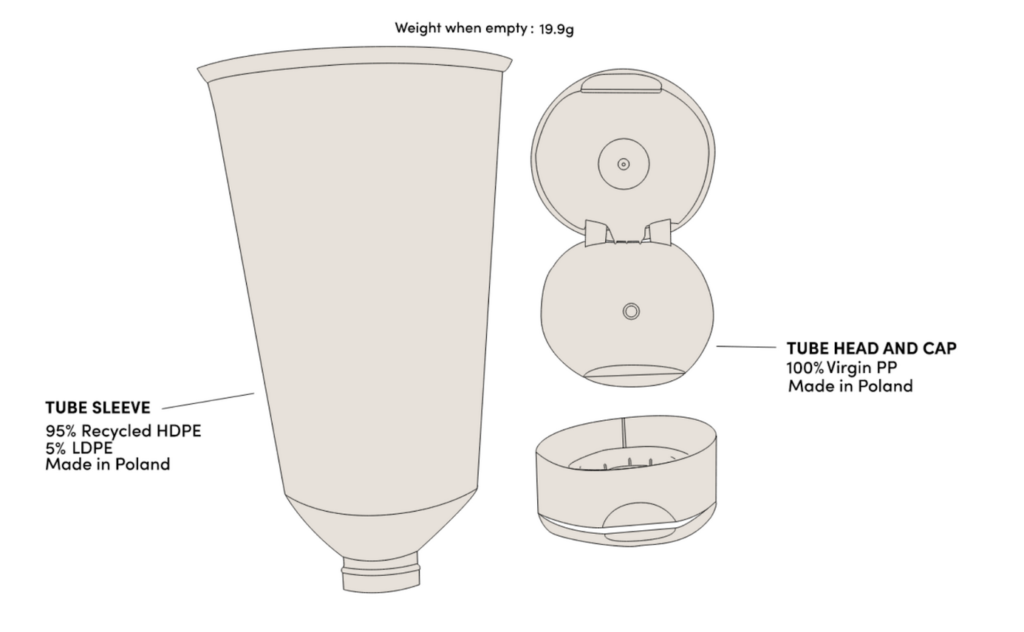
Lumessentials tube, explained
Secondary packaging: our thoughtful (and necessary) box
The plastic problem Aluminum tubes are delicate and have limited space for the legally required product information. As much as we wanted to eliminate secondary packaging entirely, a protective box was necessary. So, we committed to choosing the most environmentally conscious option available.
The box is made from FSC-certified paper. The Forest Stewardship Council certification ensures no illegal deforestation, promotes sustainable forest management, and helps conserve biodiversity. Additionally, the box is not laminated and is 100% recyclable.
But we didn’t stop there. We decided to use every millimeter of that paper to give something back to nature. After all, the more conscious our choices, the greater her benefit. Don’t forget to peek inside your box for a little surprise.beyond the buzz words
Sources
- OECD Global Plastics Outlook (2022) – https://www.oecd.org/en/about/news/press-releases/2022/02/plastic-pollution-is-growing-relentlessly-as-waste-management-and-recycling-fall-short.html
- Geyer, R., Jambeck, J. R., & Law, K. L. (2017). Production, use, and fate of all plastics ever made https://www.science.org/doi/10.1126/sciadv.1700782
- Beyond Plastics & The Last Beach Cleanup (2021): The Real Truth About the U.S. Plastics Recycling Rate https://www.beyondplastics.org/publications/us-plastics-recycling-rate
- The New Plastics Economy – Rethinking the future of plastics (2016, p.21) https://content.ellenmacarthurfoundation.org/m/1775fbba280fa21/original/The-New-Plastics-Economy-Rethinking-the-future-of-plastics.pdf
- U.S. Environmental Protection Agency (EPA) – Plastics: Material-Specific Data https://www.epa.gov/facts-and-figures-about-materials-waste-and-recycling/plastics-material-specific-data
- European Environment Agency – Biodegradable and compostable plastics — challenges and opportunities https://www.eea.europa.eu/en/analysis/publications/biodegradable-and-compostable-plastics-challenges-and-opportunities
- Plastic recycling in Europe https://circulareconomy.europa.eu/platform/sites/default/files/euric_-_plastic_recycling_fact_sheet.pdf
- Aluminum recycling https://www.aluminum.org/Recycling
- International Aluminum Institute (IAI) – global industry data https://international-aluminium.org/resources/aluminium-recycling-fact-sheet/